Thursday, 8 December 2011

Peru Part 1: History, Mystery & Damn Good Gastronomy

A first-class train ticket buys you a fashion show, a live band, cocktail-making demonstrations and a man in a mask purring in your ear. A very early morning start gets you a flight over mysterious shapes that some believe to be a message from aliens. A cup of boiled cactus tea with Shamans gives you strong hallucinations said to heal the body and connect you with the Divine. A willingness to eat like a local gets you some of the best food you've ever eaten.

Welcome to the unique, diverse and incomparable country that is Peru.

There are two things you'll find in the whole of Peru: a massive amount of dust and locals who really hate tourists taking their pictures. After that, every region in Peru is as different to one another as a region can be. Every town has its own look, identity, landscape and culture. At first I didn't think much of the country, despite having wanted to come here for ages. But Peru has a magic; a way of just getting under your skin anyway and making you love it and appreciate its variety, history and energy.

We started in Lima, the capital. If you want to know why Peru is considered the gastronomic capital of South America then you need to come and eat in Lima. And I mean EAT. None of this "I only want incinerated food because I'm a fragile tourist with a sensitive tummy" business, because if you do that, you'll really miss out. We didn't plan to leave Lima like so many other travellers we met with a bagful of regrets because they hadn't tried the best ceviche in the world.

Various countries in South America argue over who came up with ceviche first. Having tried it in every place we've been to so far, we can safely say that only people who make it as amazingly well as the Peruvians can be considered the true masters. Chunks of supremely fresh raw sea bass, loads of lime juice, some chilli and red onion, a sprinkling of fresh coriander, and some sweet potato and corn on the side.. that's it. I've re-evaluated my belief that Italians are the number one experts in delicious simplicity. We ate ceviche for lunch and dinner every single day for a week. On top of that we ate another traditional raw fish dish called tiradito and Imran had meat coated with the famous anticucho marinade as often as he could get it. We went to a restaurant called Tanta which is run by the man considered to be the best chef in Peru. I tell you, if a person can create a simple side salad so unbelievably delicious that you nearly weep with joy then you know you're in the company of a palate that is pure genius.


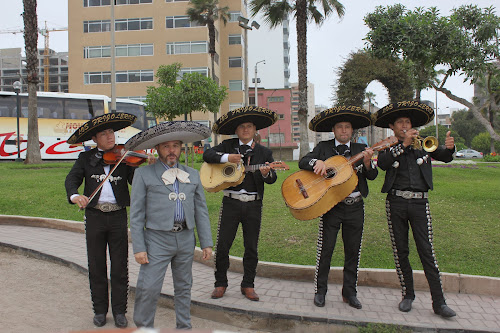
Lima is either very well-developed or in the process of becoming very well-developed. The modernisation is massive here and Miraflores - the part of town where we stayed - feels like you could be in any European city. Normally I wouldn't view that as a positive but here it just seemed to work. Probably because there is still a distinctly visible Peruvian identity and the modernisation lacks the desperation of many other countries that have a "we'll take anything American/European no matter what it is" feel. There are small parks all along the waterfront with fun names such as the 'Love Park,' where snoggers gather and singers with guitars and big hats randomly appear to serenade the lovers. Feeling inspired by the romantic atmosphere, Imran told me he had a surprise for me and proceeded to walk me to.. the Food Museum. My goody gosh, excited much?! That man knows me too well. And just by having a museum dedicated to their national cuisine makes me adore those Peruvians even more. Shame it was all in Spanish and I couldn't understand it. But being the foodie geek I am, I took photos of the entire exhibition to translate when I'm back home (yes, you read that correctly. I'm a nerd and I'm proud!)


Moving on from the breathless excitement that was food museums and ceviches, we went south to the sand dunes in Ica. An entirely different landscape to Lima, Ica is the second driest area in South America with only about 2mm of rain per year. 2mm! Don't we get that in London approximately every hour? Crickey. And yet, randomly, in the middle of this desert, there is an oasis in the form of the Huacachina lagoon. It's all so odd and all so beautiful. We just needed to look up and we could see gigantic mountains of sand towering all around us. And what's the best thing to do when confronted with this particular natural beauty? Sand board, of course! With crazy drivers who liked to race up the dunes and then jump over them so violently you have a split-second feeling you're in a real life version of the end scene of Thelma & Louise, we drove up to dizzying heights and then threw ourselves down the dunes on mini surfboards. I think I had far more fun than Imran did here. I just lay on my stomach and pulled myself over the edge of the most vertical looking dune I could find. Imran tried to use his snow boarding skills and go down standing but ended up falling every five feet. He might have been frustrated but it made for some great action shots!


We left Ica to go to Nasca on Imran's birthday. We celebrated by being in a coach for several hours watching depressing films like Frozen (don't watch it, please: you'll never ever ski again) and awesome films like Taken (Liam Neeson is a bad-ass!) Arriving in this small town, we befriended a young waiter called George in a local restaurant who made sure we had amazing ceviches and fresh juices to rival those in Lima as long as we had lunch at his restaurant every single day (we did - not just because he kept up his end of the bargain with incredible food but because Imran thought George was the poodle's doodles for saying he looked 24 years old.) We went to the local Planetarium to hear theories about the existence of the famous Nasca lines and to look at Jupiter. Imran was worryingly excited about seeing Jupiter - there you go, love: that's your 32nd birthday present.

I've been dying to go to Peru ever since National Geographic did a special on the Nasca lines a few years ago. The mystery of the lines is one of the most fascinating and interesting I've heard and it baffles people to this day. In the Nasca desert, there are lines and shapes (a monkey, spider, 'astronaut', hands, birds and various others) created by moving ground rocks to the sides and flattening the earth between them. These ancient geoglyphs cover an area of 50 miles and the shapes can only be seen in that form from above; it's estimated that they took many generations to create and have stood the test of time (since 400 AD) only due to the extreme dryness of the region. Why were they built? Why can they only be seen from above, centuries before planes were invented? What was their purpose? Theorists argue between religious and astronomical purposes, equinox and solstice significance, practical purposes of roads leading to water sources, and even aliens! But nobody knows for sure and who knows if anybody ever will. It's a really cool mystery and flying over the lines to see the mighty magnitude of them was amazeballs (no, I don't know what that term means either but my little sister once used it to describe something particularly awesome so I'm just trying to be "down with the kids.")


No time in Nasca can be complete without seeing something of the Shamans - intermediaries between the spirit and human world, and people who believe that mending the soul is the key to mending the physical body. You can spend time at healing retreats, hallucinating from drinking the juice of the San Pedro cactus. You all know I would love to try stuff like that but it's not Imran's cup of cactus tea. Instead, we visited a cemetery to see real remains of ancient Nascans and Shamans. These were the 'specialists' - those capable of entering the spiritual realm to receive guidance and advice about matters afflicting their communities. Once again, I love the attitude towards death in this part of the world. Ancient Nascans believed in the afterworld and so would party like it's 1999 at funerals to make sure the departed soul went to its next life happy. If the deceased saw everyone upset, he or she would enter the next life sad. Not to be miserable or gloomy or anything, but you'd all do well to remember that if we suddenly popped our clogs! Rose champagne, JD & coke and carrot juice, people. That's us all over.


Sunday, 4 December 2011

The Inca Trail

The age-old debate.

No, not whether the chicken came before the egg but what hurts more - childbirth or a kick in the nuts. Come on, the answer is pretty obvious. I don't even need to have had any experience of the former (promise, Mum) to know that men couldn't handle spending hours pushing the equivalent of a tennis ball out of their penises when half of them believe they're on their death bed when they have a bad cold. The only reason the debate even exists is because women don't make a big fuss about childbirth. The happiness at the end of it makes them forget the hard moments and they skim over these with a: "Ooh, it pinched a bit but it was SO worth it."

It's always the same. It's what we all say when we've been through something that physically and mentally pushed us to the limit but had a positive end result which inevitably makes us view the bad times through rose tinted glasses. You get through it, you feel happy and proud, and the fact that you wanted to punch the nearest person suddenly becomes something that "wasn't that bad."

What's my point?

Well, the Inca Trail is like childbirth. Ask anyone who's done it before you and they say: "It was difficult but totally worth it." Ask Imran & I right now how we feel about having just completed it and we'll say: "It was tough but it was worth it." However, my nightly diary of the Trail tells a very different story.. and that's the one you're going to hear now. The completely truthful day-by-day account, warts 'n' all, as we felt it, without any of this "ooh, but the fact that I didn't go to the loo for four days for fear of slipping over in sh*t didn't mean it was THAT bad" business.

Let's have a brief history lesson first. The Incas were a really groovy bunch of people; an ancient civilization so advanced they were performing brain surgeries centuries ago. I love their religious philosophy. Nature was God. Live with nature, respect it and know its strength is always mightier than your own. They worshipped the Andean mountains and volcanoes as God and built cities all over South America on this terrain. The trail we did was the longest; a four day trek covering over 40km with the majority of the trail being a part of the actual pathways built by the Incas. The goal? To get to Machu Picchu or 'The Lost City of the Incas,' a site of ruins of an estate believed to be built for the Inca Emperor Pachacuti.

Day 1: They say this is the easiest day. It's a mere 10km of 'Andean flats' which is the guides' term for land that is a constant "up and down, down and up." Trekking in blazing heat takes a bit of getting used to, as do the t-shirts stuck to your back like a second skin and soaked with sweat but agreed, it's not physically the toughest day. But if, like me, you weren't in the mood to start the Trail just yet, then it's a full-on mission to get yourself through the day. I was in a bad mood, I struggled more than I should have because I was wishing the whole thing to be over with every step and negativity ain't gonna help anyone on the Inca Trail. Poor Imran was really worried about how he'd survive the next few days if I continued to be such a barrel of laughs.

Day 2: But all was well because I did what I usually do when I'm in this kind of negative state of mind and had a long talk with myself. Some might call this a sign of madness but if the result is I snap out of it and decide to view things wholly positively then what harm is there in a little nuttiness? So we started day 2 as happy bunnies. Good job too, as the second morning is considered to be the hardest part of the trek - a continuous steep, rocky, uphill climb for 9km. Most of it is made up of steps which, in true Inca style, are so deep that we felt like we were raising our knees higher than our chests just to get on up. And there was me thinking the Incas were short. (But nope, it's just me who's short!) It's a killer on your glutes, quads and lungs because as much as you take deep breaths, it's not enough when you're climbing up to 4200m altitude. Of course, we were well aware that altitude sickness pills could've helped but those who know me well know my response was obviously: "Screw your Western medicine. I'd much rather suffer a little headache and have mild trouble breathing fully than put chemicals into my body that do more long term harm than short term good." What surprised me was that Imran said the same. "We're into natural stuff," he said to the guide, making me grin with joy at his first ever use of the word "we" in this context. Then he got out his coca leaves - the plant from which cocaine derives and which is a natural energy boost and altitude aid - and chewed on a whole bunch until his mouth became numb.

So with our muscles, lungs and skin burning (thanks, sun), we slowly but positively made our way to the top point. After this it's easy, they say. Just downhill steps all the way to base camp... bollocks, is it!


Just before we reached the peak I mistakenly said: "Wish it wasn't so hot!" Crikey, you don't say things like that in front of the mountain Gods! The Incas believed the mountains ruled the weather. My wish was a bit like saying "If I wear a seriously low cut top I hope people don't stare at my knockers" - of COURSE it's going to happen! And so it started to rain. And rain and rain and rain. And then the wind started up, nearly blowing us straight off the mountain top. This so-called easy downhill bit? It wasn't made up of steps, for a start. It was just a long hike down steep rocky terrain (something that scares me more than the average person due to a slightly unnatural fear of breaking my elbows.) It mightn't have been so bad if it weren't for the rain. But the slippery rocks meant we both took a tumble, with me adding an extra mighty fall to the equation which sent me rolling down several metres leaving bits of skin off my arms on the rocks above me and a twist on my ankle. It was so cold that my fingers were too numb to grab hold of anything. It was at that point I almost felt like crying and that the Inca Trail was definitely NOT worth this. But I obviously didn't cry because I'm not a bloody baby and definitely not a quitter, so we dug deep and carried on. Ignoring our clothes soaked right through with cold rain and the hunger in our tummies from having not eaten a proper meal since 6am (it was now 4pm), we finally made it to camp and prayed for the Trail to be over as soon as possible.

Day 3: Surprising, then, that we started day 3 positive, happy and on a mission to "smash it up." We were determined to not get caught in the predicted afternoon rain again and that meant trekking like we'd never trekked before. Getting up at 4.30am, Imran and I growled and roared through breakfast like determined lions and then practically ran for eight hours. It just goes to show, your body is fitter than you think it is and can keep on going - it's your will that makes things difficult. Day 3 is also considered to be one of the hardest as it's 16km long and a dizzying variety of steep uphill climbs, even steeper downhill treks and Andean flats. But nothing was going to stop us today. Not even my ankle. I asked our guide what would happen if someone had an injury at this point. "They would not be allowed to continue the Trail," she replied. Screw that! There was not a chance in hell I was going to stop now. So, how to deal with the pesky pain in my foot? Visualization, of course.

I'm sure this is just a load of rubbish to many people. A mind-body connection doesn't exist (of course not, that's why nobody ever blushes when they're embarrassed or sweats when they're self-conscious.) To visualize something as being well when it's not requires a mindfulness and full focus that is usually too difficult for me to achieve for long periods of time. But there's something about the Inca Trail. Some might call it the spiritual energy of the mountains; I simply call it the concentration required for every single step of the hike. Whatever it is, mindfulness for an entire day is easy here and anyone is capable of finding the mental strength needed to convince their brain that their ankle is ok. After a couple of hours, it worked. And continued working for the remaining 2 days and 24km.

So anyway, it did rain in the afternoon of the 3rd day. But we were so far ahead by that point that we didn't get caught in it for too long. It was a great day for us. The most beautiful day scenically and our strongest day both mentally and physically. Even so... we were ridiculously relieved that there was just one day left.

Day 4: The final day started at 3.15am. You'd think there was a positivity in the air, that 500 people would feel a sense of community; proud and excited that we'd all done this together and were soon to see one of the new Wonders of the World. But no, you get a lot of 'box tickers' on this adventure: people who are doing it simply for the sake of saying they've done it rather than to appreciate the magnificence of the ancient path they are literally treading. These people start the final day with a chip on their shoulders and fierce competitiveness to push and barge past every other person in a bid to make it to Machu Picchu first. They're the same people who yell to their friends: "Hey duuude! You think if I throw this cigarette over the edge I can set a f**kin' cloud on firrre?" and the ones who moan: "Dude, this is really frickin' dangerous here. It's like, they don't give a crap if I like sue them for breaking my leg, man. They need to make this path safer, duuude." (It's an ancient path built centuries ago, not one created a few months ago by the tourist office purely for your presence, dumb ass.)

After a relatively easy 6km march, we made it to the Sun Gate at the top of the mountain just after dawn. From here we could see Machu Picchu at a distance and the view was breathtaking. There was a mist in the air from a night that had only recently finished, the skies were clear and there was an eerie, mind-blowing calm that just filled every cell in our bodies. It was magnificent. For me, it was a better destination than Machu Picchu itself which, although beautiful, lost the magic close-up due to the tourists, the slightly unrealistic restored walls and manicured patches of grass that reminded me of looking down into the Tower Of London grounds.


Far from being finished, we decided (ok, I did) for some loony reason that it'd be a great idea to climb Wayna Picchu, a ridiculously steep and exposed hike up another mountain 1200ft above Machu Picchu. This isn't really worth doing if you've just done the four day trek. It was simply hardcore exercise (as if we hadn't worked hard enough already!) to see the same view from a higher summit. Sure, it was gorgeous, but it was also scary because we were literally one foot slip and trip away from plummeting down to our deaths (yes, slightly over-dramatic.) But we did it - getting seriously sunburnt in the process - and then finally rested our tired legs and aching knees after a 100-hour endurance test.


So, what's the verdict? Physically, the Inca Trail is hard but fantastic. If I worked out liked that every single day I'd look like Cris Cyborg in no time. It's easy to not shower or know what you look like for four days. Everyone smells and looks the same! The end result of seeing Machu Picchu is not worth doing the trek for, but the end result of the feeling of pride, satisfaction and sense of achievement definitely is. To be with nature and to be mindful non-stop for this amount of time fills you with a joy and contentment which we were surprised to find residing within us afterwards. We couldn't believe how happy and peaceful we both felt that afternoon. What would stop us from doing the Inca Trail ever again is the state of the toilets. I expected bad but I didn't expect SO bad that I would never do this trail again for this reason alone. Camping is not our cup of tea but we could easily do it again. But our guide told us the trail is a protected site and they can't build decent loos here. They are literally holes in the floor Indian-style which smell horrific and are dirty as hell - nobody has any idea if the floor is covered in rain and mud or pee and poo. Imran and I had to give each other a consolatory hug after every visit just to feel better about the minging nature of it all.

If, like us, you've never gone camping before, the Inca Trail is a pretty crazy place to start. If, like us, you've not really hiked before, the Inca Trail is a pretty hardcore trek to throw yourself into. If your fitness levels are average, you'd be mad to think the Inca Trail won't test you. By these standards, we must be doolally to have done this. But what we found we had in abundance was a determination and mental strength that can override any limitations of physical fitness and hating of the circumstances.

In summary, it was really tough but definitely worth it... but just the one time!


Saturday, 19 November 2011

Honey, I've Shrunk The Heads: Mainland Ecuador

"Miserable f**kers."

That was Imran's characteristically blunt description of the Ecuadoreans. Why didn't he people-watch, read about the history and politics, and try to understand why the people behaved a certain way? "Because that's your job," he explained. Fair enough. And that's why I'm writing the blog and not him - you might have an essay to read but at least I'm nice.

Our first stop in Ecuador was the capital, Quito. From there we travelled down the centre of the country to Banos and, after a Galapagos detour, finished in Guayaquil on the west coast.
Do you want to hear about the good stuff or bad stuff first? Let's start with the bad so that we can finish on a positive note!

Quito sucks. Ok, that's a bit harsh but it's not somewhere we'll hurry back to. Although there are some really great things to see in the city, the overall culture epitomises the resentment and anger that builds up within a predominantly young male population living in one of the poorest countries on the continent desiring all the material things they see coming from America which their Latin neighbors with a better political structure are far closer to having. There's a mass exodus of young guys out of the country to find work in better environments, leaving behind the lads who all look identical in their desperately-wannabe-American styling.

In the airport, while we may have been pushed and shoved out of the way with huffs and tuts galore and received scowls in return for smiles, the young men who left in search of a better life are welcomed back with flowers, balloons, hugs, kisses and an intense tearful joy that can only come from people dejected and heartsick that their sons / grandsons / nephews whom they love so deeply have to leave them.

And this makes Quito absolutely no different to many other cities all around the world. So why the attitude that we see all the time was more noticeable to us here probably has something to do with our high expectations of the place. We'd read that this was a nation defined by the friendliest and nicest people in South America and it was simply a surprise to not be greeted with this; in reality, the people are collectively no more grumpy than Londoners. Bear in mind also that we'd just spent time in Mexico where the people are wonderful - Ecuadoreans could do acrobatic shows in sparkly speedos for us and they'd still be miserable by comparison! Quito just seems to lack an identity; it's run-down and without charm or character. It felt bleak and unsafe. And we stayed in the nicest area in the city.

So what DID we like about this city? Actually, a lot of things. They're crazy about karaoke here. There are karaoke bars everywhere but, of course, Imran and I aren't into that..! The artwork is amazing. Quito is known for its artists thanks mostly due to the sculpture and paintings culture introduced by the Spaniards and the famous Escuela Quitena they set up. We didn't bother going to any of the recommended art galleries - partly because art galleries bore the crap out of us - but mostly because you only need to look on the streets to find (in my opinion) the best art. Graffiti covers practically every inch of every wall and I felt as if this is where the real personality could be found. One one side of a road you'll find the usual signature scribbles combined with angry shouts about political traitors, democracy and using condoms, and on the other side you'll find the most beautiful images covering any subject matter: religion, politics, sex, food, emotions, random stuff... The stark contrast between the streets and the impressively green and imposing backdrop of the Andes is what makes Quito interesting.


Quito sits on the Equator so a monument and a museum dedicated to this invite tourists to straddle both sides of the line and stand simultaneously in the northern and southern hemispheres. (I would just like to point out that I'm terribly childish because I had a little giggle when I wrote 'straddle'!) It's definitely not as hot here as we expected because being right on the equator actually means you can get all four seasons of weather in one day. The museum is GREAT fun. We learned some very interesting things.. so here come your fun facts for today! (NOT for the faint hearted.)

Admit it (even you ladies): you've peed in places where you shouldn't have, right? The sea, a pool, your grandmother's kitchen sink? Well, if you went for a dip in the Amazon river and thought it was ok to relieve yourself, you'd be in for a mighty big shock. The Amazon is home to the Candiru or 'penis fish,' a tiny 'toothpick' sliver of a fish which is attracted to urine. One sniff of glorious ammonia and the Candiru races towards the scent and right up into a man's best friend. Once inside, it erects an 'umbrella' of backward-pointing spines so, if by some miracle you caught the little devil by its tail poking out, you'd tear yourself to pieces trying to pull it out. Then it starts feasting on the closest blood-gorged membrane. Nice, huh? Remember that story next time you pee in your brother's pond. (Amir, I SWEAR that's a joke; your pond is as pure as holy water!) We're going to the Amazon on the Brazil leg of our trip - not gonna pee for three days just to be sure...

Think pin-heads are a bad thing? Not to the Amazonian Wuaorani tribe who used to take the heads of their dead enemies, remove the skull so only skin remained, boil it to shrink it, wrap it around a small rock and wear it around their necks. Check out this real life shrunken head!


We did some really cool experiments like balancing an egg on a nail - something which apparently can only be done exactly on the equator - and taking away each other's strength when one foot is on the line (it really works!) Call us big kids but we left Quito with a big smile after that. Even after we stupidly went against advice to walk anywhere at night rather than take a taxi and went out one evening to a place only five minutes away from our hotel, and encountered some very dodgy blokes and very scary prostitutes (are you sensing a common theme here? I promise we don't intentionally seek out street walkers!)


Driving south from Quito along narrow, winding roads built precariously on mountain edges, we arrived in the small town of Banos overlooked by the Tungurahua volcano. We wanted to come here for the adventure sports for which it's famous - rafting, mountain biking etc - but with Imran being ill we simply relaxed instead. Our hotel was high above the town in the mountains and beautifully built in a way to use and show all five natural elements (including wood) at their best. It was a very uplifting place and it felt good to just soak up the energy and enjoy being in the hot pools of volcanic water. Every street had stalls selling fresh sugar cane juice with rows and rows of the giant canes leaning against the walls. We haven't eaten sugar cane since we were kids, when our parents used to buy some from the Indian shops during the in-season and we'd sit there for ages just sucking on the fat pieces of fruit. Talk about nostalgia.


Having made a detour from the mainland to visit the Galapagos Islands, we ended our travels around Ecuador with a night in Guayaquil. All I can say is: GUTTED we weren't here for longer. We loved this place so much. Finally, the famous Ecuadorean affability and charm we'd heard so much about! And boy, were they friendly. Passing people on the streets in our taxi, I smiled and received not only big smiles but waves in return. Reading the menu in one of the million juice bars around (yay!) we had total strangers helping us choose a drink and recommending theirs. We talked to one girl who was so jolly she actually jumped when she spoke - I'm not even exaggerating. The city is well-developed due to twenty years of 'urban regeneration' and there are many things to see, notably the 444-step climb in the Las Penas neighbourhood for views over the whole central area. I wish we had spent more time in Guayaquil (and preferably less in Quito) but hey, you live and learn and it just means we need to come back here in the future. Any of you chicas planning a hen do / extravagant birthday anytime soon??
It'll be a few weeks before I write again due to an action-packed fortnight we have planned. It's time to go to Peru and make a dream come true.


Adios amigos xx


Tuesday, 15 November 2011

"Love You Like An Albatross": The Galapagos Islands

The Albatross are a group of birds endemic to the Galapagos Islands. They mate for life so it stands to reason they're very careful in their selection of partner. A male and female will spend up to a year getting to know and trying to impress one other before finally deciding to make the all-important lifetime commitment. Sounds just like mine and Imran's story. He thought so too. "Love you like an Albatross," he said. Shucks.

But then our guide told us the male goes back to the island of choice to ensure the nesting area for future eggs is ok. He arrives a few days before the female and in that time, being the horny devil he is, pounces on any other birds (pun intended) who may have landed in the wrong spot and has his wicked way with them. The poor female Albatross, faithful and loyal to the male she's chosen, lays the 'bastard' egg but then abandons it. And in the meantime, the male Albatross welcomes back his original chosen mate with open wings. "Ok, I don't love you like an Albatross," Imran said. "Really... I swear."
There you go, folks: your fun fact for the day.

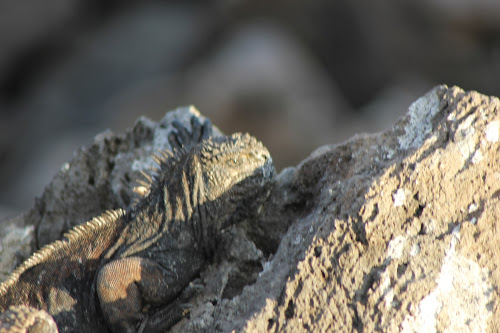
We've just finished our week sailing around the Galapagos: eighteen islands in the Pacific ocean, each with their own distinctive wildlife. And it's just incredible. White sandy beaches with black rocks and turquoise waters, lagoons, volcanic rocks, snorkelling twice a day with colourful fish and sting rays and sea lions and hammerhead sharks, treks to see iguanas, flamingoes, dolphins, giant tortoises and an enormous variety of birds. If you love nature, wildlife, spectacular scenery and both walking and swimming alongside all of these, this is the place for you. Each island is like a personal zoo but with the animals roaming free in their natural habitat.


Spending a week in a boat with fourteen other people - eating all meals together, trekking everywhere in a big group; basically spending 24/7 with them - meant we really hoped we'd find some people we got along with. We got very lucky and made some great friends on this trip, primarily an Aussie couple and a group of six Americans we nicknamed 'The Chicago Crew'. We had a lot of fun with these guys - they were hugely energetic and lively and had great stories to tell of their global adventures. That was one of the best things about this cruise for us - we met people we would otherwise never cross paths with and will hopefully make some lasting friendships.


On Floreana Island there's a small patch known as the 'post office' with a little wooden box in which people leave postcards for loved ones. The tradition is that when you go to the postbox, you not only leave your own card but take out some already in there and either post or hand deliver them to the addressees. I think the idea is to meet new people but it's a guessing game as to how long it'll take for your card to be delivered: weeks, months or even years. We took a few out with London addresses on them but I haven't decided yet whether to simply post them or actually take them personally when we're back in London. Lex and Suzanne, just so you know, we left you a letter in there with 'To Be Personally Collected Only' written on the front. There are no two people we know who would love this archipelago more than you guys. It's just the most perfect place for wildlife enthusiasts and we'll keep bugging you to go for as long as it takes! And when you do, there'll be a note waiting for you in the postbox dated Nov 2011.


So are you ready for another fun fact to finish? I don't want to bore you with any more written details of the cruise when it's much better to see Imran's fantastic photos instead. But I'll tell you about the blue-footed boobies. We were lucky enough to see a courtship and mating between two of these birds with, as you may have guessed, blue feet. The male will offer the female a twig (cheap date) and if she accepts, he'll jump on her (he didn't even have to buy her dinner) and do the deed for the grand old time of four seconds. Literally - we counted. He then walks around holding his head up very proudly before they finish with a dance: leaning to the side lifting one foot off the ground and then again on the other side. It's a genius dance and one that Imran & I are going to attempt to turn into a trend in the London clubs when we're back.


Hope you're all doing well! xx


Friday, 4 November 2011

Don't Think, Don't Breathe, Don't Stop: Eating Our Body Weight in Mexico


Those of you who know Imran probably think it's impossible for him to ever gain weight. It's highly likely you believe he'll live to a ripe old age having never known what it's like to be subject to the trials and tribulations of expanding waist lines and increasing clothes sizes as the rest of us normal folk. Despite his ample appetite, our very own Benjy Button has a metabolism that just seems to improve with age. Well, let me tell you, none of you thought to send him to Mexico. Spend a few months here and even 'Slimran' may eventually become Fatman.

I, on the other hand, am already showing signs that I may soon be unable to see my feet. Not being much of a breakfast person usually, I've been following the "when in Rome" rule and dining like a king every morning just like the locals. Specifically, Henry VIII! Of course, the saying goes that you should then lunch like a prince and supper like a pauper but in Mexico the food is simply too good to deny yourself royal status at every meal.

Three quarters of our meals have been street food as worries about dodgy stomachs sure as hell ain't gonna stop us from eating the tastiest food available! So far it's been pretty good going. Imran's had to get the Immodium out once or twice but me and my iron stomach have felt fantastic - despite eating a lot of raw food washed in local water - thanks to a potent daily cocktail of probiotics and Spirulina. And that includes in places where the hygiene has been so bad that it looks like the guy who made our food wiped his arse with his bare hands first.

Real Mexican food is very different to the Tex-Mex stuff we get back home. They put tortilla chips in and with everything, plus some more on the side. As well as a hefty portion of soft tortillas just for fun. They're included in some way or another in every dish at every meal. Vegetarianism is a sin; a dirty secret best kept well hidden. In Playa Del Carmen I made the mistake of asking for veggie food for the first and last time: "Can you do me a veg version of the chicken tacos?" I asked. "Of course! It would be the chef's pleasure," the waiter responded enthusiastically. These tacos were originally filled with chicken and rolled up and fried. I took a bite into mine expecting to taste vegetables or beans of some sort. It was totally empty. Just an empty taco. And thats about as much respect as a vegetarian will get in a touristy place like Playa. Good job I'm not a full-time one!

But elsewhere there's still plenty for them to eat. We could live off guacamole and beans and fresh salsa; the latter, however, not being as common as we expected and disappointingly substituted for a bowl of bottled chilli sauce more often than not.

But the street food! Oh my good God, the street food! Tacos: soft corn tortillas cooked in front of you, spread with a layer of earthy beans, commonly topped with chicken in a spicy sauce. Empanadas: a larger tortilla filled with your choice of protein and either a fiery red or refreshing green sauce, accentuated by just a couple of aniseed-flavoured leaves and simply grilled. These leaves varied from region to region - avocado leaves in some areas and 'hoja santa' leaves in places like Oaxaca - but the flavour imparted was the same.

Chilaquilles: beans and sometimes chicken cooked in a red or green sauce, then with tortilla chips added and baked, finished with a topping of fresh crumbly crema. Crema is fresh, homemade cheese and unbelievably easy to make. Milk is warmed and an acid such as lemon juice is mixed in, making the dairy curdle. Drained through a muslin cloth, the curds and whey are now separate and the former are left to firm up. It's similar in texture to ricotta but a more salty flavour (the Mexicans love to pile on the sodium!) We only ate chilaquilles once in Mexico City but we truly believed the dish we had was the best we could hope to have, so we didn't order it again just to ensure our memory was nothing but positive! It was creamy without being overbearingly rich, fragrant from the herbs in the sauce and full of different textures, from the tortillas within the sauce going part-soggy and liquid-drenched to the crispy ones on top.

Ceviches: raw fish 'cooked' in a zesty marinade of lime, orange, tomatoes, onions and chillies. Then there were the sopes (another version of tacos but with a much thicker tortilla); the cheese-stuffed but still light quesadillas and enchiladas; the papadzulles, the panuchos, the fresh fish grilled on an open flame caught just hours before in the coastal areas. In Oaxaca we relished the various types of mole - the Mexican equivalent of curry - with a sauce paste made from dozens of ingredients. The most famous one is the mole negro which contains chocolate. It was a taste explosion. Deep (fancier people would describe it as 'complex'), sweet and spicy, a myriad of flavours hitting your tongue in every direction.

What else? Tamales, meat stuffed into a cornmeal (masa harina) paste and grilled in a banana leaf; chilled rellenos (stuffed chillies), ancient Aztec tortilla soups, and my personal favourite, nopales, a tangy salad made from cactus.. the list is endless and you can see why we stuffed ourselves silly, gorged our guts, munched through meal mountains.


The Mexicans know what real chocolate is. Forget the milk-filled rubbish: the good stuff is in Latin America. Dark, crumbly blocks of raw cacao are used in the savoury mole, sold just as they are, or broken up into pieces in the bottom of a mug with hot milk poured over to create a the creamiest and most delicious hot chocolate in the world. Even a man might be convinced to describe it as better than sex. Cacao, just to hit you with a Fun Fact (pronounced 'cuh-cow'), is the proper name for the chocolate bean but the Europeans who came to this part of the world couldn't pronounce the word for this ancient Aztec beauty, and so 'cocoa' was born. And we've all been calling it that ever since.


Being the juice addicts that we are, we obviously hoped to find some freshly squeezed orange juice at the very least. We did in Merida. In Mexico City and Oaxaca City we got even luckier and found 'juguerias' where we drank green vegetable juices, pints of our all-time favourite carrot, apple and beetroot juice, and litres of smoothies made with the freshest and sweetest papayas, guavas, pineapples and oranges. The man who ran the juice stall in Oaxaca's market came to know us as the English couple who got strangely excited by juice and learned to look out for us several times a day!


Although very difficult to rate, our top three meals were in Cafe Tacuba in Mexico City, a beach shack in Puerto Escondido and a breakfast in Oaxaca City. Cafe Tacuba simply because the setting was as Mexican as it gets and the food was delicious and simple. The breakfast in Oaxaca, although not as tasty a meal as a lot of the street food we ate, was memorable because we ate with a group of wonderful people we met earlier that morning, and sharing food with friends amidst laughter and chatter is one of life's greatest pleasures. And it was also our first introduction to Mexican hot chocolate! The beach shack was an entertaining meal. We were the only people in the place and the warning signs of dirty glasses and cutlery were there but we ignored them. The toilets were a "walk in and walk the hell back out immediately" kinda thing, obviously having not been flushed for about a month judging by the contents and the swarm of flies. The sink didn't work and instead there was a communal bucket of used water to wash our hands. And for some strange reason that we still don't comprehend, we stayed. Was it because we had already ordered and our British sensibilities didn't want to offend or be awkward by walking out? Whatever the reason, we just sat there annoyed and in a bad mood about what a disgusting place we'd come to, both of us seething at my poor choice of raw food, refusing to touch our drinks because the waiter had left muddy brown droplets from his dirty wet hands when he put the straws in.

And then the food arrived.

Tentatively we both took a bite from our grilled fish and ceviche. And nearly passed out... from happiness. The food was incredible. The most delicious ceviche I'd eaten and the nicest fish Imran had eaten so far. My dish was tart from limes but just as I was about to purse my lips from the sourness, a hit of sweetness came to surprise me before I finished with a kick in the mouth from some warming chilli. Imran's fish was charred on the outside and white and flaky on the inside. Spot on. We wolfed it all down, not giving a monkeys about the hygiene or the chances of getting ill or anything other than the fact that this was damn good grub! Even the dead ant in my dish didn't deter me - it's all flavour, right?

We learned something about ourselves that day: tasty food is of utmost importance on this trip and we don't care if the cleanliness is questionable in getting it to us - just as long as we don't see it! Ignorance really is bliss. We're the Lakhas and we're disgusting.

Remember that pact we had about saying yes to everything? Well, we failed. Whilst eating in the market an old lady tried to sell us a handful of fried insects sprinkled with chilli. The voice in my head was screaming "Try it! Try it!" but in the end, we couldn't say yes. Actually, Imran's exact words were: "F*ck that! You get that sh*t away from me, little lady!"

At the end of the two weeks, we couldn't take any more. Our bodies shut down. We held a forkful of food up to our mouths at our final Mexican dinner and couldn't bring ourselves to put it in. The non-stop shovelling had taken its toll and now our bodies were screaming "No more, please - I'm full! I'm short and small framed; obesity ain't a natural or sexy look on me." And fortunately we listened, contentedly sated from the amazing food we'd eaten in this brilliant country but thankful it was now ending and we could drag our heavy arses to a country with a less gluttonous food culture.